Welcome to 2024!
What will this year offer for NORBAG book artists? What are your goals or
wishes for 2024? Do you hope to learn new structures or techniques, or are you
looking to perfect the skills you currently possess? Probably it is a little of
both. Have you made any resolutions regarding book art for 2024 that you could
share with us? We would love to hear about your ideas, accomplishments or
suggestions. Let’s make 2024 the year we all try something new and share it
with our fellow NORBAGERS!
Our first workshop of 2024 will be an Origami-Fold Book taught by Carol DuBosch. This delightful, folded structure is made without sewing or gluing: the folds on the spine both secure the pages and hold the book together. If lightweight paper is used for the pages, two or more pages can be inserted into each spine section and folded together. The size and proportions of the book can be varied; however, the structure works best with a horizontal or square format. Regardless of the proportions of the Origami-Fold Book, the width of its spine is always equal to the height of its pages.
Supply List:
- Printed PDF files: to be sent upon your RSVP
- Bone Folder
- X-Acto Knife
- Cutting Mat
- Metal Ruler
When: Saturday, January 13 at 10 a.m. PSTWhere: On your computer, tablet, or smartphone via Zoom
RSVP: To Dolores Guffey by January 8 to receive the password and PDF
Workshop Questions: Carol DuBosch
Zoom Questions: Bobbie Hayes
Contact information is in the Newsletter
A Book of Days
by Betty Steckman
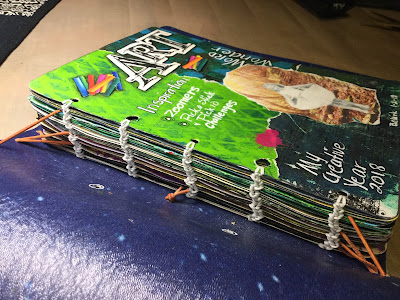
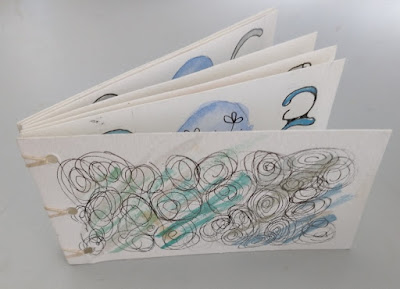
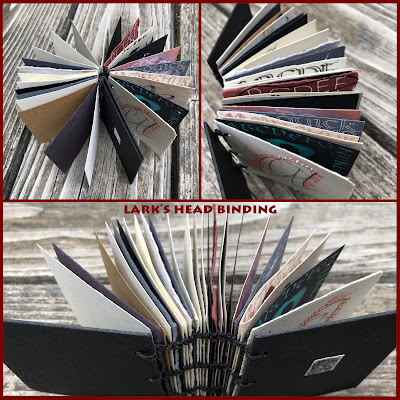
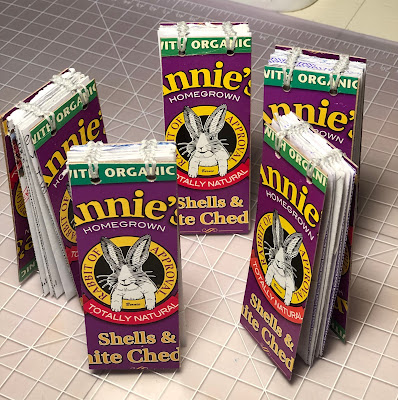
Stuck? Out of ideas? Maybe a Book of Days is just the thing to get your mind in gear again. A Book of Days is like a small journal or scrapbook that you can work on for a week or a month or as long as you like, and put into it whatever pleases or comforts you. You can use scraps from your paper stash and odd bits and pieces that you've been saving for no particular purpose. You can get fancy with your book structure, but you don't have to--this book is just for you.
The discipline of making a Book of Days is to do something every day of the month. It doesn't have to be much--a rubber stamp, a sticker or two, a leaf, a limerick or a favorite quote. Or it could be more elaborate, like a tiny collage. Sometimes I've written about what happened that day or how I felt. I write about the weather sometimes, or the phase of the moon. Some of my books feature historical events or celebrations. I've included poems appropriate to the season, haiku that reflect my grief or joy, silly rhymes or sayings, a Biblical quote or two, a song lyric. the point is to put something, however small, on paper every day.
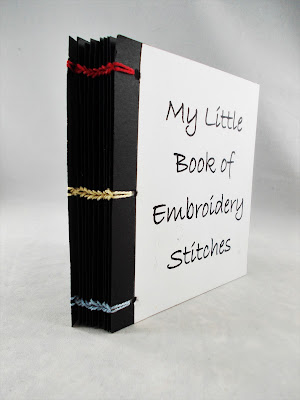
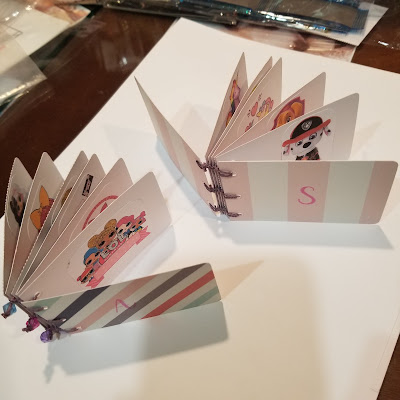
Sometimes my pages are all one color and type of paper, but often they're a hodgepodge of different colors and textures. You can add pockets, pop-outs, inserts, folds, pull-outs--whatever pleases you. You can bind your pages any way you like. Many of mine are bound as multiple signatures over ribbons, with hard covers. A few are stab-stitched; and two have a Coptic binding. Sometimes I do the pages first and then bind them, and sometimes I make a blank book with enough pages for the month, and fill it in as the month progresses. Sometimes a day takes a double-page spread, sometimes only one page.
The first Day book I made was in March 2012. It was a real mess in some ways because I made it quickly with odd scraps pieced together. I was in a hurry to get the structure made in February of that year because my favorite cat was dying, and I wanted a blank book to write in after she passed. Many of the pages include haiku or quotations about loss and grief, but there were also happy days, and I was sure to commemorate them as well. It's still a comfort and pleasure to turn those pages and remember those times.
And then there were the two books I made in 2020--May and December. It was important to me to chronicle what it was like to live through that first year of the COVID lockdown. Several of the pages feature cartoon images of knights in full armor setting off to go grocery shopping or run some other errand. I noted on two or three pages the terrifying statistics on hospitalizations and deaths. There were some dark cartoons here and there, like the iconic doctor of the Middle Ages, fully cloaked with his black hat, stick and beaked mask. These books are sobering to look through, not much fun but they tell an important story.
But I have the most fun with the books that focus mainly on notable events and people, with a sprinkling of quotes and poems appropriate to that month. Famous people's birthdays, holidays and commemorations offer many possibilities. All of the books I've made so far have given me a little project each day, supplied an outlet for my thoughts and emotions, and like a snapshot, have frozen in time things that were important or enjoyable. It's a very freeing exercise, to make a record of whatever you want in whatever format you want, and in the process use up some scraps and have a creative blast with just the nudge of doing something every day.
Give it a try!


.JPG)